
Destinations
New Zealand's Great Walks: The Four Almost Nobody Books
Key takeaways
- Booking pressure on the famous Great Walks is a booking problem, not a crowding problem nationwide.
- The quiet walks still have huts, but the booking window stays open far longer.
- Weather is the real difficulty on every Great Walk regardless of how busy it is.
- Shoulder season turns a quiet Great Walk into an almost empty one.
Booking a New Zealand Great Walk has become a competitive activity in its own right. The most famous routes open their booking windows months ahead and the popular huts fill within hours. What that obscures is that the Great Walks network is not uniformly crowded — it has a small number of heavily subscribed routes and several that stay remarkably quiet while offering the same huts, the same track quality and, in a couple of cases, better scenery. If the booking system has put you off, these four are the answer.
Why the quiet ones stay quiet
The pattern is consistent. The busy Great Walks are busy because they are short, accessible from a major town, and famous. The quiet ones require either more driving to reach the trailhead, more days to complete, or a tolerance for weather that is genuinely worse than the postcard suggests.
None of those are quality problems. A longer drive filters out day trippers. A longer trip filters out people with a week's holiday. Worse weather filters out people who want reliable sunshine. What remains is a well-maintained track with bookable huts and a fraction of the people on it.
There is also a feedback effect. People book what they have heard of, and what they have heard of is what everyone else booked, so reputation stays concentrated on a handful of routes regardless of what the rest of the network offers.
Hump Ridge Track and the Hollywood Route
At the southern end of the South Island, the Hump Ridge Track climbs from the coast through native forest to a subalpine ridge with views across to the fjords. It is a three-day loop, it starts near a small settlement rather than a tourist town, and it combines three landscapes — beach, forest and alpine — that most Great Walks only manage one of.
The track includes a historic viaduct, a stretch of coastal walking that is genuinely remote, and a ridge section where the weather decides everything. In clear conditions the views rival anything on the more famous routes. In bad conditions the ridge is committed and exposed, and that is part of why it stays quiet.
Because it is a loop, there is no transport problem at the far end, which removes one of the usual logistical headaches of a point-to-point Great Walk. Huts are comfortable and the booking window stays open far longer than on the headline routes.
The Darran Mountains and the Routeburn alternative
Most people who want the Routeburn experience book the Routeburn. The alternatives on the same side of the ranges give you similar alpine scenery with a fraction of the traffic, and several are day walks or short overnighters rather than full multi-day commitments.
The Darrans are a compact, steep, dramatic range of granite and forest. Routes here include access to alpine lakes, hanging valleys and a good deal of very serious mountaineering terrain. For a walker rather than a climber, the valley approaches give remarkable scenery without requiring technical skills.
The practical advantage is flexibility. Because you are not locked into a booked hut sequence, you can choose your day based on the forecast, which on this side of the ranges matters more than anywhere else in the country.
Lake Waikaremoana
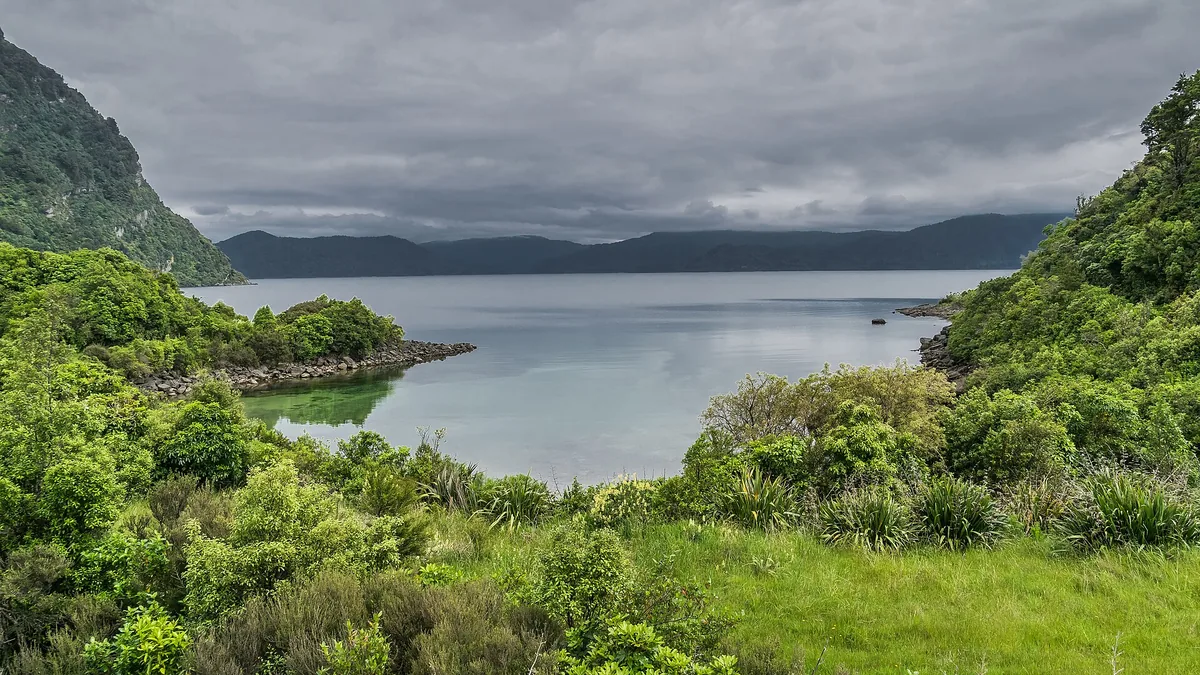
On the North Island, Lake Waikaremoana is a three to four day lake-edge track through dense native forest, and it is consistently one of the least busy Great Walks despite being one of the most varied. The track follows the shoreline, climbs to lookouts over the lake, and passes through forest that has recovered substantially since the logging era.
The quality that stands out is the forest itself: large mature trees, thick understory, and birdlife that is noticeably more active than on tracks with heavier traffic. Walking quietly through it early in the morning is the highlight, and it is a highlight that depends entirely on there being few people around.
Logistics are simple — it is a loop with a single road access point, camping and huts are both available, and the booking pressure is modest. It is also the Great Walk most often described by those who have walked several as the one they would return to.
Rakiura Track on Stewart Island
Stewart Island, off the southern coast, is the least visited part of the country's main inhabited island group, and the Rakiura Track is its Great Walk. It is a three-day loop through coastal forest and along beaches, and it offers the thing the mainland tracks cannot: a genuine sense of isolation combined with Dark Sky sanctuary status.
The birdlife is the reason to come. Because of predator control work on and around the island, species that are absent or rare on the mainland are active here, and the difference is obvious within an hour of walking. Stewart Island is also one of the few places where you may see a kiwi in the wild.
Getting there requires a ferry or a small plane, and the weather is serious. Both are reasons it stays quiet, and both are manageable with planning. Build in a spare day either side of the walk for weather-delayed transport — this is not optional logistics advice on Stewart Island.
The weather reality nobody photographs
New Zealand's mountain weather is the actual difficulty on every Great Walk, quiet or busy, and it is consistently underestimated by visitors. The country sits in a band of strong westerly airflow, and the Southern Alps intercept it, which means the western side receives enormous rainfall and the ranges generate their own weather regardless of forecast.
Plan for rain on most days and treat sunshine as a bonus. This is not pessimism; it is the difference between an enjoyable trip and a miserable one. Proper rain gear, a dry layer kept sealed, and the willingness to sit in a hut for half a day are what make these trips work.
River crossings are the specific hazard. New Zealand has no bridges on many backcountry routes, and a river that is knee-deep in the morning can be impassable by afternoon after rain in the headwaters. Learn to assess a crossing, know when to wait, and treat a rising river as a hard stop rather than an inconvenience.
Huts, camping and how booking works
Great Walk huts are bookable through the conservation department system, and the booking window typically opens months ahead. The busy routes fill quickly; the quiet ones often have availability much closer to the date, and that flexibility is one of their practical advantages.
Huts are heated, have bunks with mattresses, running water or a tank, and a cooking area. You carry your own food and sleeping bag. Camping is cheaper and available at most Great Walk campsites, and on the quieter tracks the campsites are often nearly empty.
Outside the Great Walks, the backcountry hut network uses a different pass system with serviced, standard and basic categories at different prices. If you plan to walk more than one track, work out which pass structure is cheaper before buying — it is not always the one that seems obvious.
Shoulder season is the single best lever. Walking any of these in late autumn or early spring transforms a quiet track into an almost empty one, at the cost of colder huts and more weather risk.
What a Great Walk hut is actually like
Manage your expectations here and the whole experience improves. A Great Walk hut is not a mountain hut in the European sense, and it is not a hostel. It is typically a heated communal building with bunks in shared rooms, mattresses but no bedding, a cooking area with gas or a solid-fuel range, a water supply that may or may not need treating, and toilets that are usually long-drop or composting.
You carry your own sleeping bag, food and cooking equipment. There is no shop, no meal service and no luggage transfer unless you have booked an operator that provides it. During peak season a hut can hold dozens of people in bunks arranged along a wall, and privacy is essentially the inside of your sleeping bag.
None of that is a complaint — it is the point. The hut is shelter, warmth, a dry place to cook and a shared table, and those four things after a long day in the rain are worth a great deal. The social side is usually the part people remember: everyone is wet and tired and eating the same kind of food, and conversations start easily in a way they do not at home.
Hut etiquette is simple and worth knowing. Arrive with enough food, because nobody can sell you any. Keep your pack off the bunks. Dry wet gear in the designated area rather than over the heat source. Wash your own dishes. Keep noise down after dark, because people are starting early. And pack out everything you brought in, including food scraps, because there is no collection service on the trail.
Conclusion
The crowded reputation of New Zealand's Great Walks applies to about three of them. Hump Ridge, Waikaremoana, Rakiura and the Darrans approaches give you the same standard of track and hut, comparable or better scenery in places, and a booking window that does not require an alarm at midnight. Accept that it will rain, treat every river crossing seriously, build a spare day into any trip involving a ferry, and go in shoulder season if you can. The quiet tracks are not the consolation prize — several of them are the better walk.
Keep reading
Beyond Machu Picchu: 8 Inca Sites Almost Nobody Visits
Choquequirao, Wari terraces and fortress complexes that see a fraction of Machu Picchu's visitors. Where they are and what the hike involves.
Europe's Deepest Canyon Is Not Where You Think: The Tara River Gorge
The Tara River Canyon cuts deeper than most famous European gorges. How it formed, how it compares to the world's big canyons and how to see it.
The Lakes That Vanish Every Year and Come Back: Seasonal Lakes Explained
Karst sinkholes, glacial outbursts and evaporating basins create lakes that drain and refill on a schedule. Where to see them and why it happens.
