
Destinations
Beyond Machu Picchu: 8 Inca Sites Almost Nobody Visits
Key takeaways
- Choquequirao receives roughly one percent of Machu Picchu's annual visitors.
- Most alternative Inca sites require multi-day treks rather than a train and a bus.
- Acclimatize in Cusco before any of these; several sit above 3,000 meters.
- Permit requirements vary widely — some sites need nothing, others need a licensed operator.
Machu Picchu receives well over a million visitors a year and operates on a timed-entry system that must be booked months ahead. Ninety minutes away by road and a long walk, there are Inca sites where you may be the only visitor for the entire day. The difference is not quality — several of these sites are as impressive as Machu Picchu in scale and setting — it is access. Each one requires a hike, and that hike is precisely why they stay quiet. Here is where they are and what getting to them actually involves.
Why these places stay quiet
Access is the whole story. Machu Picchu is reachable by train and bus, which means it is reachable by anyone with a day and a ticket. Every site on this list is reachable on foot, most of them over multiple days, and that single filter removes the overwhelming majority of visitors.
The second filter is permits. Some of these sites require a licensed guide or a restricted-area permit by law, which caps numbers structurally rather than by accident. Where that is the case, it is worth understanding the requirement before you build an itinerary around a place, because it affects both cost and flexibility.
These are not secrets in any absolute sense. Archaeologists know all of them, and specialist operators run trips to several. They are quiet relative to the scale and quality of what is there, which is a different and more useful claim.
Choquequirao
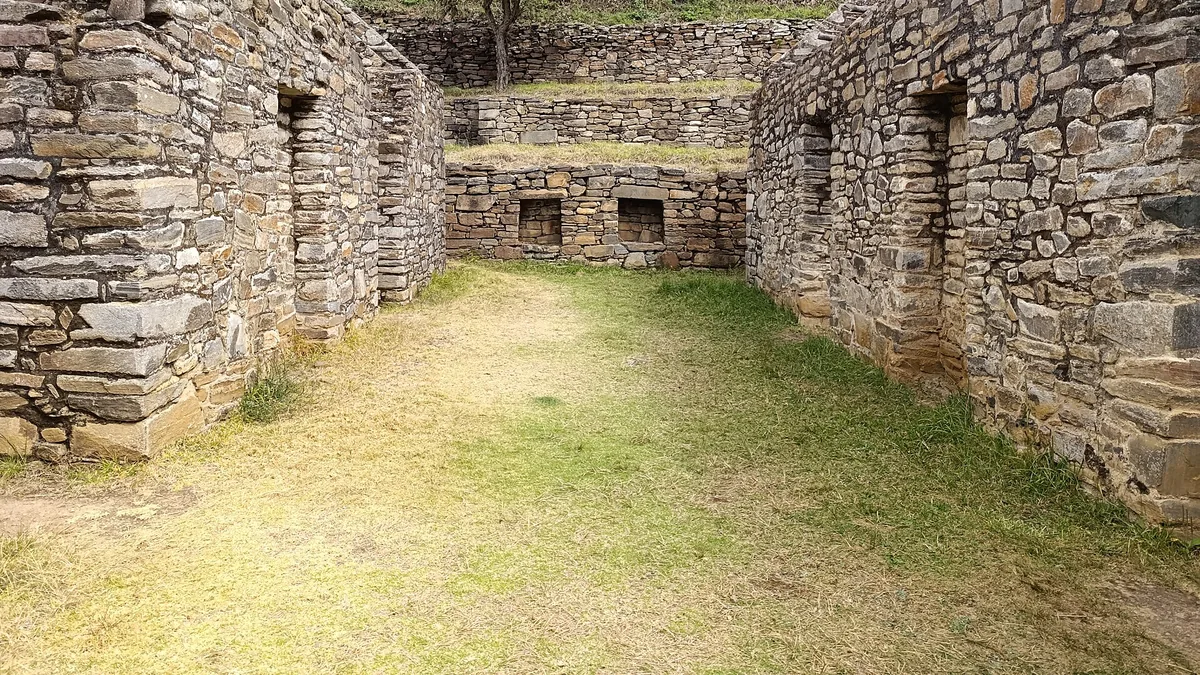
Choquequirao is the one that gets called the sister city of Machu Picchu, and the comparison is deserved. It sits on a ridge above the Apurímac canyon at around 3,050 metres, with terraces, plazas, and a hillside of white stone structures that archaeologists estimate is only partially excavated. The setting is more dramatic than Machu Picchu in one specific respect: the canyon below it is enormous, and you see the site in the context of a landscape rather than as an isolated citadel.
The standard approach is a four to five day round trip from the trailhead, descending into the canyon and climbing back out on the far side. That descent and re-ascent is the crux of the trip — roughly 1,500 metres of descent and a similar gain on the return, in heat that at the river level is genuinely tropical. Most people underestimate this and pay for it on the climb out.
There is now talk of a cable car project that would transform access. Whether or not it proceeds, the current reality is that reaching Choquequirao is a commitment, and that commitment is the reason you will likely have the terraces to yourself at sunrise.
The Wari sites north of Cusco
The Wari culture preceded the Inca by several centuries and built at a scale that is only now being properly understood. Sites in the Ayacucho and Cusco regions include substantial stone architecture, terracing and road networks, and they receive almost no international visitors.
What makes these interesting is the contrast. Inca masonry is famous for its precision; Wari construction is rougher and more massive, and walking between the two traditions within a single trip makes the Inca achievement clearer by comparison. Several Wari sites are close to paved roads, which makes them an easy addition to a Cusco-based itinerary rather than an expedition.
They are also largely unsigned and unstaffed. Bring your own context — a guidebook or an offline map with coordinates — because arriving without knowing what you are looking at wastes the visit.
Moray and Tipón
These two are closer to Cusco and therefore not entirely undiscovered, but they remain far quieter than the Sacred Valley sites on the standard circuit, and both are remarkable.
Moray is a set of concentric circular terraces cut into a natural depression. The temperature difference between the top and the bottom of the bowl is several degrees, which is why it is usually interpreted as an agricultural research station where crops were tested at different altitudes. Standing at the bottom and looking up at the rings is the best way to understand it; photographs flatten it badly.
Tipón is an engineering site: an extraordinary set of terraces fed by a spring through a system of channels and aqueducts that still function. The water is still running, the stonework is still intact, and the whole complex demonstrates Inca hydraulic skill more clearly than anywhere else in the region. It is one of the most underrated sites in the Cusco area and it rarely appears on standard itineraries.
Huchuy Qosqo
Huchuy Qosqo means little Cusco, and it sits on a terrace above the Sacred Valley with views across to the snow-covered range beyond. The site includes a substantial main building, terraces and an aqueduct, and its position suggests it was a regional administrative centre.
The appeal is the approach. You can walk there over a high pass from the Sacred Valley in a long day, or descend to it as part of a two-day trek, and either way the arrival gives you the view that the site was clearly built for. It is also one of the few significant Inca sites reachable on a day hike without a permit, which makes it an excellent option if you want to escape the Sacred Valley crowds without committing to a multi-day trek.
Into Vilcabamba
Vilcabamba was the last refuge of the Inca after the Spanish took Cusco, and the region holds several sites that are genuinely remote. Vitcos and the site known locally as Espíritu Pampa require multi-day treks through cloud forest, with significant river crossings and mud that does not let up.
This is the least visited part of the Inca story and the most demanding to reach. Expeditions here need porters or pack animals, a licensed operator, and a realistic attitude about weather. What you get is a landscape that looks much as it did when it was a refuge, and sites that have been excavated but not reconstructed for visitors.
If you have already hiked Choquequirao and want the next step, this is it. It is not a place to attempt without previous Peruvian trekking experience.
Acclimatization and timing
Nearly everything on this list sits above 3,000 metres, and several of the approach routes cross passes above 4,000. Spend at least two full days in Cusco before starting any of these, and treat that as part of the trip rather than as an optional extra. Altitude affects people unpredictably, and previous fitness does not predict who struggles.
The dry season runs roughly from May to September. Outside it, the trails become genuinely difficult — the descents into canyons turn slick, and river crossings that are trivial in July become serious obstacles in January. The trade-off is that shoulder months bring far better light and far fewer people, so a late April or October trip can be a good compromise if you accept the risk of rain.
Temperatures vary enormously with altitude on these routes. You can start a day at 4,600 metres in freezing wind and finish it at 1,500 metres in tropical heat. Layering is not optional here, and the range is wider than on most treks anywhere.
Permits, guides and practicalities
Requirements change, so verify before booking. Some sites require nothing at all, some require a ticket purchased at a regional office, and some fall inside areas where a licensed guide is mandatory. Budget for the guide where it is not optional — it is also what makes some of these routes navigable, because the trail is not always obvious.
Cash matters in the villages near these trailheads. Card acceptance is limited and ATMs are unreliable away from Cusco, so carry enough soles for mules, camping fees, meals and tips. Pack animals and porters are arranged locally, and agreeing clearly on what is included before you start avoids most disputes.
Finally, be realistic about what "quiet" means. It means you may be one of six people rather than one of two thousand. It does not mean no infrastructure, no local communities, and no need to plan. These places are lived-in landscapes, and treating them as empty is both wrong and a good way to have a bad experience.
Conclusion
The Inca built far more than one citadel, and the rest of their architecture is still standing for anyone willing to walk to it. Choquequirao rewards a four-day commitment with a canyon setting that arguably beats the famous site. Moray, Tipón and Huchuy Qosqo are reachable in a day from the Sacred Valley and see a fraction of the traffic. Vilcabamba is the expedition option for people who want the last chapter of the story. Acclimatize properly, go in the dry season, check permit requirements before you book, and you will spend most of these visits in near silence.
Keep reading
Europe's Deepest Canyon Is Not Where You Think: The Tara River Gorge
The Tara River Canyon cuts deeper than most famous European gorges. How it formed, how it compares to the world's big canyons and how to see it.
New Zealand's Great Walks: The Four Almost Nobody Books
Most hikers book the Routeburn and Milford. These four Great Walks get a fraction of the traffic with the same alpine and coastal scenery.
The Lakes That Vanish Every Year and Come Back: Seasonal Lakes Explained
Karst sinkholes, glacial outbursts and evaporating basins create lakes that drain and refill on a schedule. Where to see them and why it happens.
