
Safety
Cave Diving: Why It Kills Divers Who Did Everything Right
Key takeaways
- An overhead environment removes the single option that saves open-water divers: ascending directly.
- Silt-outs can drop visibility to zero in seconds, which is why line discipline is non-negotiable.
- The rule of thirds on gas is a planning minimum, not a conservative choice.
- Certification level correlates strongly with survival; most fatalities hold no cave rating.
Cave diving has a fatality profile that does not resemble any other adventure activity. The people who die in caves are not typically beginners. They are often experienced, well-equipped, technically trained divers who made a decision that would have been survivable in open water and was not survivable under a rock ceiling. Understanding why requires understanding one structural difference, and once you see it, the accident statistics stop looking mysterious.
This article is about risk and about why the activity demands formal training. It is not a guide to cave diving, and it should not be read as one. Cave diving without specific certification is the single defining risk factor in the fatality data, and no amount of open-water experience substitutes for it.
The one structural difference: overhead
In open water, any problem can be solved by ascending. Out of air, ascend. Panicking, ascend. Lost, ascend and orient yourself. The surface is always there and it resolves almost every failure mode.
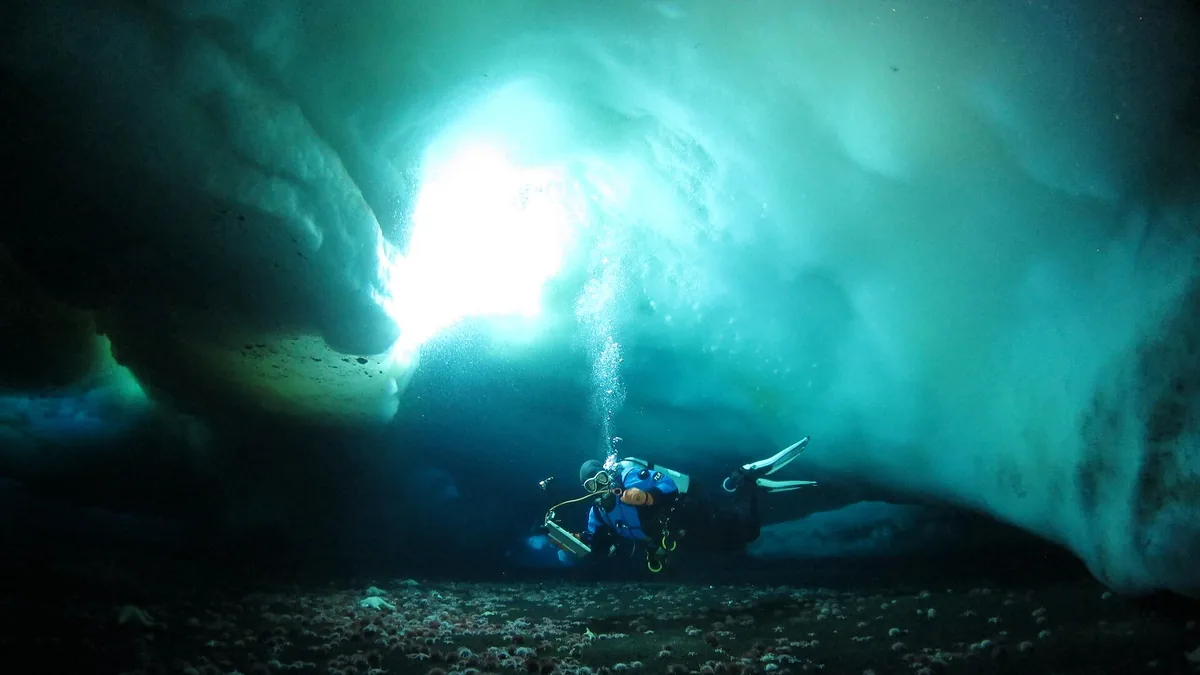
In a cave, there is no direct ascent. A rock ceiling separates you from the surface, and the only way out is the way you came in, along a passage that may be long, narrow, silty and completely dark. Every problem that open water solves with an ascent becomes, in a cave, a problem you must solve while continuing to manage depth, gas, buoyancy and navigation simultaneously.
This single change — the removal of the emergency exit — is what makes the activity categorically different rather than merely a harder version of the same thing. It converts most equipment failures from inconveniences into emergencies, and it converts most judgment errors from recoverable into fatal.
What the fatality data consistently shows
Accident analyses conducted over decades by training agencies and safety organisations reach the same conclusions repeatedly.
The overwhelming majority of fatalities involve divers without cave training. This is the strongest and most consistent finding. Divers entering overhead environments with open-water certification, or with cavern certification pushed beyond its limits, account for most deaths.
The second consistent finding is gas mismanagement. Running out of breathable gas before reaching the exit is the terminal event in a large share of accidents, and it is frequently a planning failure rather than an equipment failure. The gas was there; the plan did not account for the consumption rate under stress, or for the time required to exit.
The third is disorientation — losing the line, or losing the exit direction. In a silt-out, visibility can go from clear to zero in seconds, and in zero visibility a diver who is not in physical contact with the line has, in practical terms, no way to find it reliably.
Equipment problems are relatively rarely the primary cause. This is important: it means these accidents are not caused by gear failing, but by decisions made before and during the dive.
Silt-outs: losing the world in seconds
Cave floors accumulate fine sediment. A diver who fin badly, who overweights and drags along the bottom, or who simply passes through a constriction at the wrong angle can lift that sediment into suspension. In the confined space of a cave, it does not disperse.
A silt-out can reduce visibility to zero faster than most people believe possible. Divers describe it as being inside a liquid version of a thick fog, where even a powerful light produces nothing but backscatter. The cave has not changed; you simply cannot see any of it.
The training response is line discipline and buoyancy control, and they work together. Good trim and a proper fin technique keep you off the bottom and out of the silt. Continuous contact with the line means that when the visibility goes, you already know where the exit is.
The untrained response — swimming forward looking for an opening, or trying to ascend — is what converts a silt-out from an inconvenience into a fatality. The correct response is to stop moving, establish contact with the line, and exit along it.
Line discipline: the system that makes caves survivable
Cave diving runs on a continuous line from open water to the furthest point of penetration. Every diver follows it, every diver can find it in zero visibility, and every diver knows how to identify the exit direction on it by touch alone.
The rules are not arbitrary. A continuous line means there is never an unmarked section between you and the outside. Markers at defined intervals tell you how far in you are without needing a computer. Directional markers, such as arrows pointing to the exit, are placed so they can be read by feel in total darkness and full silt.
Gaps in a line are treated as a serious problem, and a diver who finds one stops rather than continuing to look for it on the far side. Jumping to a different line without laying a connecting line is the specific behaviour that has killed experienced divers, because it converts a known route into an unknown one.
The deeper principle is that the exit must be knowable at every moment without relying on memory, visibility or instruments. Everything in cave diving procedure is built around protecting that guarantee.
Gas planning: why thirds are a floor, not a margin
The rule of thirds is the basic planning framework: use one third of your gas to get in, one third to get out, and keep one third in reserve for an emergency. In a cave, that reserve is not generous — it is what allows you to share gas with a buddy whose supply has failed, or to handle a delayed exit.
Experienced cave divers frequently plan more conservatively than thirds, particularly in long or complex passages, because the assumption that the exit takes the same time as the entry is often wrong. Swimming out against an outflow, managing a silt-out, or assisting a buddy all take longer than the inbound leg.
Redundancy is the hardware side of the same principle. Independent first stages, isolatable manifolds, and redundant gas supply mean that a single regulator failure is a procedural event rather than a crisis. The test of any configuration is whether you can shut down a failure and continue the dive on what remains.
Turn pressure is the discipline that enforces all of it. You agree a pressure at which you turn the dive before you enter, and you turn at it regardless of how well the dive is going. The failure mode that kills people is not running out of gas unexpectedly; it is noticing that the gas is getting low and deciding to continue a little further.
Why experienced divers still die
This is the question the activity is most often asked, and the answer is uncomfortable. Experience in cave diving does not remove risk; it changes which risks are live.
Experienced divers go further, into more complex environments, with more complex gas mixtures and longer decompression obligations. Each of those additions brings new failure modes: incorrect gas switches at the wrong depth, decompression obligations that cannot be met after a delay, and multiple stage cylinders that must be managed in sequence.
Experience also brings familiarity, and familiarity is how turn pressures get extended and how marginal conditions get accepted. A diver who has done a passage twenty times in good conditions may treat a twenty-first dive in worse conditions as routine, and the environment does not scale with experience.
The other factor is that some divers progress beyond their training without additional training. Cave certification has levels, each corresponding to a different environment and a different set of skills. Practising beyond what you have been taught, without instruction, is a recognisable pattern in the accident record.
What formal training actually teaches
Cave certification is not a badge; it is a curriculum of specific, practised responses. Students learn line handling and marking, gas planning and turn pressure discipline, redundant equipment configuration, propulsion techniques that do not disturb silt, and — critically — emergency procedures practised until they are automatic.
They also learn how to manage a lost line, a lost buddy, a total gas failure in a buddy, and a zero-visibility exit. These are drilled, not discussed, because the environment does not allow time for deliberation.
Progression is deliberate. Cave training proceeds through defined stages, from cavern to introductory cave to full cave and beyond, each adding environment complexity only after the previous one is consolidated. Equipment configuration is also taught, because a configuration that works in open water can be actively dangerous overhead.
The most important thing training provides is an honest assessment of what you do not know. Almost every untrained diver entering a cave believes their open-water experience is relevant to the risks they are about to take. It is relevant to perhaps one of them.
If you are curious about cave diving
Cavern diving — staying within sight of natural light and within a defined distance from the entrance — is the legitimate entry point, and it is a genuinely different activity from cave diving. It allows you to experience the environment while the exit remains visible.
If you want to progress, the path is: become a genuinely competent open-water diver first, with solid buoyancy and trim; add advanced and rescue training; then seek a cave instructor and follow the certification sequence without skipping stages. Expect the training to challenge assumptions you did not know you had.
Choose instructors and agencies with a documented safety record and a curriculum rather than a weekend course. Ask what the progression looks like and how much in-water practice is included. Good instructors will also tell you when you are not ready, which is exactly the feedback you are paying for.
And understand the honest summary: cave diving is a trained activity with a small but real fatality rate even among trained divers. Approaching it as a harder version of open-water diving is the mistake that the accident record is largely made of.
Conclusion
Cave diving is dangerous for one structural reason and several practical ones. The structural reason is the overhead environment, which removes the ascent that resolves every open-water emergency. The practical ones follow from it: silt-outs that eliminate visibility in seconds, gas planning that must survive delays and sharing, and line discipline that has to be absolute because it is the only reliable route out. The accident data attributes most fatalities to untrained divers and to gas and navigation failures rather than to equipment. If the environment appeals to you, start with cavern diving and a proper instructor, respect the certification sequence, and treat every rule as a response to a specific way people have died.
Keep reading

What Happens to Your Body Above 8,000 Meters: The Death Zone, Explained
Above 8,000 meters the body cannot acclimatize. What happens to blood, brain and muscles hour by hour, and why climbers still go.

Your Vehicle Breaks Down in the Desert: A Survival Checklist That Works
Stay with the vehicle, manage water, signal properly. What to carry and what to do hour by hour when a breakdown happens far from help.

What Happens Below 40 Meters: The Risks of Deep Diving
Nitrogen narcosis, accelerated decompression, gas density and oxygen toxicity. What changes as you descend past recreational limits.
