
Safety
What Happens to Your Body Above 8,000 Meters: The Death Zone, Explained
Key takeaways
- Above roughly 8,000 meters the body consumes oxygen faster than it can adapt.
- Appetite and digestion shut down, which is why climbers lose weight rapidly on summit pushes.
- Decision-making degrades before strength does, and climbers rarely notice it happening.
- Everything above that altitude is a countdown; supplemental oxygen extends the clock.
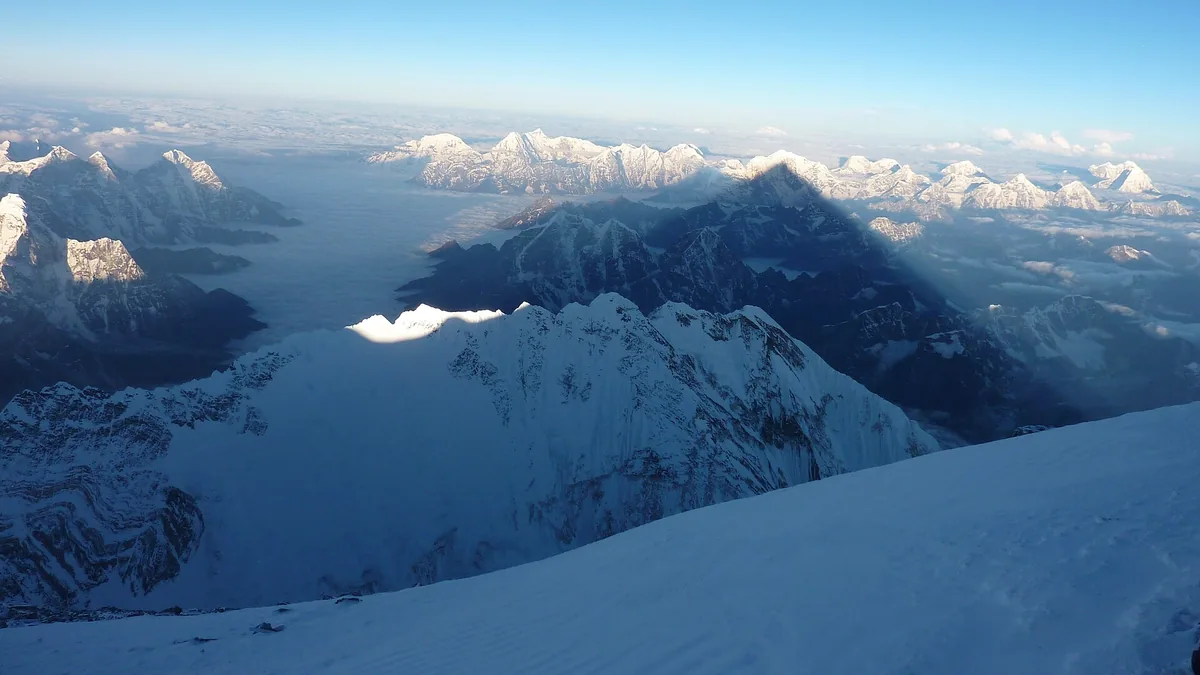
Above roughly 8,000 meters the air contains less than a third of the oxygen available at sea level, and the human body cannot adapt to it. This is why the altitude is known as the death zone: not because death is instant, but because the body is consuming its reserves faster than it can replenish them, and the clock is running from the moment you arrive. Understanding what happens hour by hour explains why climbers move the way they do, why summit pushes happen at night, and why so many of the decisions that matter get made before anyone reaches that altitude.
What actually changes: pressure, not oxygen percentage
A common misconception is that the air at altitude contains less oxygen by proportion. It does not. The fraction of oxygen in the atmosphere is essentially constant at about 21 percent all the way up through the altitudes humans can reach. What changes is pressure, and therefore the number of oxygen molecules in each breath.
At sea level, atmospheric pressure is around 1,013 millibars. At 5,500 meters it is roughly half that. At the summit of Everest it is about a third. Because the air is less dense, every breath delivers substantially fewer oxygen molecules to the lungs, and the partial pressure gradient that drives oxygen into the blood is correspondingly reduced.
This is the mechanism behind everything that follows. It is not that climbers are breathing bad air; it is that they are breathing thin air, and the physics of getting oxygen across into the bloodstream becomes progressively harder.
Acclimatization and where it stops working
The body does adapt to altitude, and it does so remarkably well up to a point. Within days of arriving at moderate altitude, breathing rate increases, heart rate rises, and the kidneys begin producing more of a hormone that stimulates red blood cell production. Over weeks, the blood carries more haemoglobin.
Other adaptations take longer: the body shifts its acid-base balance to allow deeper breathing, produces more of a compound that helps release oxygen to tissues, and increases capillary density in some tissues. These changes are the reason people can live permanently at 4,000 or even 5,000 meters.
Above roughly 5,500 to 6,000 meters, however, acclimatization slows dramatically and then effectively stops. At extreme altitude the body cannot build enough additional carrying capacity to keep pace with what it is consuming. Sleep becomes difficult, appetite falls, and the body begins breaking down its own tissue for energy. This is the threshold where expeditions adopt the climb-high-sleep-low pattern, because the only way to gain tolerance is to expose yourself briefly and then descend.
Above 8,000 meters, there is no acclimatization at all. Time spent there is pure expenditure.
What happens hour by hour above 8,000 meters
The first thing climbers notice is the breathing rate. It becomes deliberate and enormous — some describe it as taking a dozen or more breaths for a single step. At this altitude, movement is paced by respiration rather than by leg strength, which is why the famous images of climbers standing still for long periods are accurate rather than dramatic.
Digestion shuts down. Blood is diverted away from the gut toward the brain and working muscle, and appetite disappears almost completely. Climbers on a summit push may eat very little and drink surprisingly little, losing several kilograms over a few days. This catabolic state is not a failure of discipline; it is physiology.
Sleep becomes nearly impossible. Periodic breathing — cycles of deep rapid breathing alternating with pauses — wakes people repeatedly, and above 8,000 meters most climbers cannot sleep at all without supplemental oxygen. Sleep deprivation compounds every other problem, most of all judgment.
Cognition degrades. This is the most dangerous effect and the one climbers are least able to detect in themselves. Short-term memory, the ability to do simple arithmetic, and the ability to weigh a decision all decline. Climbers report later that decisions which seemed reasonable at altitude were obviously wrong in retrospect, and that at the time nothing felt unusual.
The most serious acute risks are two conditions. High-altitude pulmonary edema is fluid accumulating in the lungs, which produces breathlessness at rest, a cough and a progressive inability to oxygenate. High-altitude cerebral edema is swelling of the brain, producing confusion, loss of coordination and eventually loss of consciousness. Both are treatable by descent and both are fatal if ignored. The reliable field sign of cerebral edema is ataxia — the inability to walk a straight line.
Why supplemental oxygen changes the arithmetic
Bottled oxygen does not eliminate the problem; it moves the threshold. Breathing supplemental oxygen raises the partial pressure of oxygen in the inspired air, which makes the whole system work better without changing the ambient pressure at all.
The effect is large. Climbing above 8,000 meters without supplemental oxygen is possible, and a small number of climbers have done it, but the margin for error shrinks to almost nothing. With oxygen, the same climber has better coordination, clearer thinking, better sleep at camp and more usable time at altitude.
This is why supplemental oxygen is standard on commercial expeditions and why the decision to climb without it is one of the most consequential choices a climber makes. It is not a question of fitness or of toughness; it is about how much margin you have when something goes wrong.
Why summit pushes happen at night
Climbers typically leave high camp between midnight and two in the morning. There are several reasons, and they compound.
Snow and ice conditions are better in the coldest hours. A frozen snow slope is firm and supportive; the same slope in afternoon sun becomes soft, unstable and exhausting. Avalanche and serac risk also drops in cold conditions.
Wind tends to increase during the day. A forecast that shows a usable morning and an unusable afternoon is the normal pattern, and the morning is the part that is usable.
The schedule is also driven by the oxygen and turnaround plan. A climber leaving at midnight with a fixed turnaround time has a defined window in which to reach the summit and get back before gas or daylight runs out. The turnaround time exists precisely because the descent is where most accidents occur — climbers who summit late are descending exhausted, in deteriorating conditions, and frequently out of supplemental oxygen.
Why people still go
Given all of this, the reasonable question is why anyone climbs at these altitudes at all. The honest answers vary and they are rarely simple. Some climbers are drawn to the technical and logistical problem. Some are drawn to a specific mountain. Some are drawn to the experience of operating at a limit, and it would be dishonest to pretend that this appeal is not real.
What is consistent among the climbers who survive long careers is that they treat the altitude as an adversary to be planned around rather than overcome. They acclimatize patiently, they respect turnaround times, they descend when symptoms appear, and they accept that the mountain will be there another year. The climbers who die are frequently the ones for whom that last acceptance was hardest.
The lessons that transfer to ordinary altitude
You do not need to be at 8,000 meters for the physiology to be relevant. Mountain sickness begins for many people around 2,500 meters, and it is common on ski holidays and trekking trips at moderate altitude.
The principles are the same at every altitude. Ascend gradually where you can. Treat headache, nausea, dizziness and unusual fatigue as real symptoms rather than as discomfort to be pushed through. Drink more than seems necessary, because the dry air at altitude and increased respiratory water loss dehydrate people quickly. Avoid alcohol and sedatives on arrival, because both depress the respiratory drive that altitude depends on.
The single most important rule transfers exactly: if symptoms are worsening rather than improving, descend. Every serious altitude illness is treated by going down, and no medication substitutes for it. Acetazolamide can help with acclimatization and mild symptoms, and dexamethasone is carried for serious cases, but both are bridges to descent rather than alternatives to it.
Climb high and sleep low is the trekking version of the same idea. Gain altitude during the day, sleep lower at night, and you build tolerance far more effectively than by simply going up and staying up.
Conclusion
Above 8,000 meters the body is spending, not adapting. Breathing becomes the limiting factor, digestion stops, sleep becomes impossible, and judgment degrades before strength does — which is why the decisions that kill people are often made by climbers who feel fine. Oxygen moves the threshold rather than removing it, summit pushes happen at night because the mountain is safer then, and the turnaround time exists because the descent is where things go wrong. Most of this applies in milder form at the altitudes ordinary hikers and skiers reach: ascend gradually, treat symptoms seriously, hydrate, and descend rather than push on.
Keep reading
Cave Diving: Why It Kills Divers Who Did Everything Right
Cave diving has a fatality profile unlike any other adventure sport. Silt-outs, line breaks, gas planning and the training that separates survivors from statistics.
Your Vehicle Breaks Down in the Desert: A Survival Checklist That Works
Stay with the vehicle, manage water, signal properly. What to carry and what to do hour by hour when a breakdown happens far from help.

What Happens Below 40 Meters: The Risks of Deep Diving
Nitrogen narcosis, accelerated decompression, gas density and oxygen toxicity. What changes as you descend past recreational limits.
