
Natural Wonders
What's Inside the World's Deepest Blue Hole?
Key takeaways
- Blue holes formed as limestone caves that collapsed and flooded.
- Dean's Blue Hole is the deepest known, at about 202 meters.
- Below 100 meters the water becomes anoxic and cannot support most life.
- Microbes there survive without oxygen, informing the search for life on other worlds.
Blue holes are among the most mysterious features of our planet. These marine sinkholes plunge hundreds of meters below sea level, hiding entire ecosystems that have never seen sunlight. The deepest blue hole on Earth challenges divers, scientists, and our understanding of how life survives in extreme environments. This is what is inside the world's deepest blue hole.
What is a blue hole?
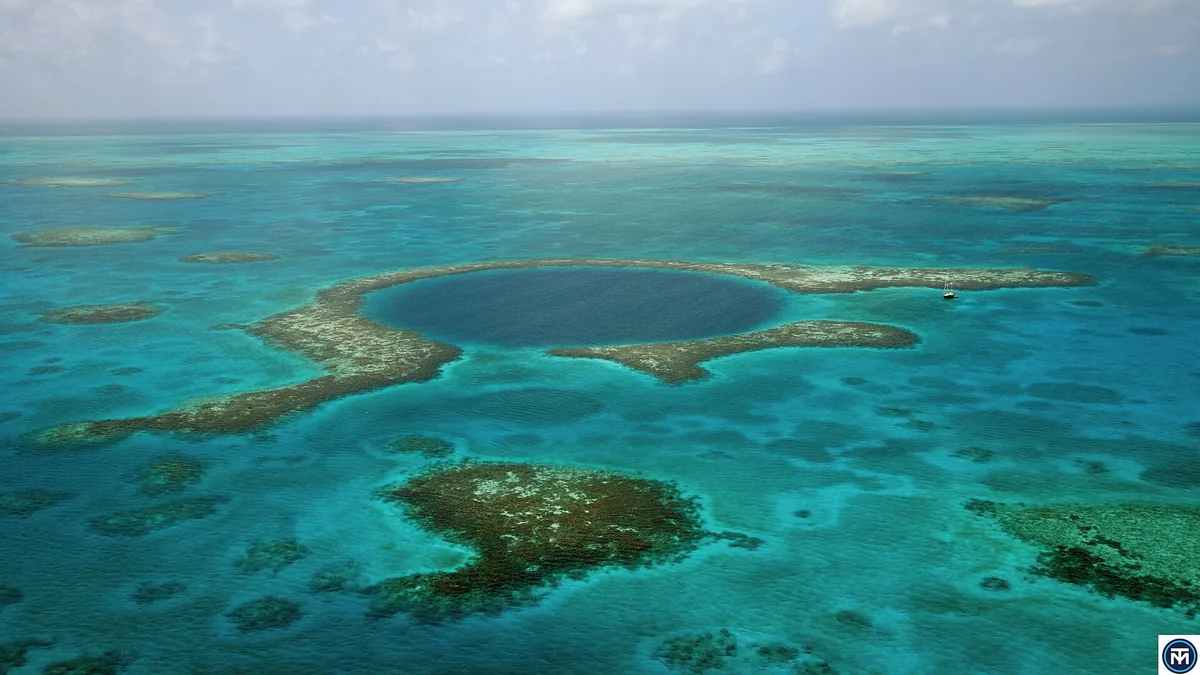
A blue hole is a large marine sinkhole or underwater cave that opens to the surface. They formed during past ice ages when sea levels were much lower. Rainwater, slightly acidic from dissolved carbon dioxide, seeped into limestone bedrock and dissolved it from the inside, creating vast cave systems. When the caves collapsed and sea levels rose again, they filled with ocean water. Seen from above, they appear as dark blue circles surrounded by shallow turquoise water, which is how they got their name.
The deepest: Dean's Blue Hole
Dean's Blue Hole, located in a bay west of Clarence Town on Long Island in the Bahamas, is the deepest known blue hole in the world. It plunges to a depth of 202 meters. The hole is roughly circular at the surface, about 25 to 35 meters across, and widens into a larger chamber as it descends. The water at the bottom is isolated from the ocean above, creating a unique environment for scientific study.
What is at the bottom?
The bottom of Dean's Blue Hole contains water with almost no dissolved oxygen. Below about 100 meters, the water becomes anoxic, meaning it cannot support most marine life. However, scientists have found bacteria there that survive without oxygen, metabolizing sulfur and other compounds instead. These microbial communities are of great interest to researchers studying how life might exist on other planets or moons with similar conditions, such as Europa or Enceladus.
Why is the water layered?
Blue holes often have distinct layers of water that do not mix. A layer of fresh or brackish water can sit on top of denser salt water. Deeper down, temperature and chemistry change sharply. This phenomenon is called stratification. At the very bottom, anoxic, sulfide-rich water may be separated from the oxygen-rich water above by a visible boundary. Divers describe the transition as crossing into another world.
What life lives in blue holes?
Near the surface, blue holes host standard reef life: fish, corals, sponges, and sea turtles. As depth increases, the community changes. Below the sunlit zone, organisms adapt to darkness and low oxygen. Scientists have discovered unique species of bacteria, foraminifera, and crustaceans living in these conditions. Some of these organisms are found nowhere else on Earth, making blue holes valuable natural laboratories.
Why do divers go there?
Dean's Blue Hole is a mecca for freedivers. Because the hole is sheltered and deep, it hosts international freediving competitions where athletes descend on a single breath to depths exceeding 100 meters. Scuba divers also visit, but extreme depth requires specialized training, gas mixes, and equipment. Recreational divers should stay within their certified limits and never attempt deep cave penetrations without proper cave-diving certification.
The dangers of blue holes
Blue holes are beautiful but unforgiving. Nitrogen narcosis, decompression sickness, and oxygen toxicity are serious risks at depth. The isolated, anoxic water at the bottom offers no margin for error. Cave-diving environments also pose entanglement, silt-out, and disorientation hazards. Only trained technical or cave divers should attempt deep descents, and even then with experienced support teams.
Other famous blue holes
The Great Blue Hole off the coast of Belize is one of the most iconic, popularized by Jacques Cousteau. It is about 124 meters deep and famous for its clear water and vertical coral walls. Dahab's Blue Hole in Egypt is another famous site, though it has a tragic reputation due to diving accidents. Each blue hole has its own chemistry, biology, and set of hazards.
Conclusion
The world's deepest blue hole is more than a beautiful curiosity. Dean's Blue Hole is a natural laboratory where scientists study oxygen-free life, and a proving ground where freedivers push human limits. From the surface down to its anoxic depths, it reminds us that the ocean still holds environments we barely understand. Respect the risks, and let these places remain protected for future study and awe.
Keep reading
Beyond Machu Picchu: 8 Inca Sites Almost Nobody Visits
Choquequirao, Wari terraces and fortress complexes that see a fraction of Machu Picchu's visitors. Where they are and what the hike involves.
Europe's Deepest Canyon Is Not Where You Think: The Tara River Gorge
The Tara River Canyon cuts deeper than most famous European gorges. How it formed, how it compares to the world's big canyons and how to see it.
New Zealand's Great Walks: The Four Almost Nobody Books
Most hikers book the Routeburn and Milford. These four Great Walks get a fraction of the traffic with the same alpine and coastal scenery.
