
Natural Wonders
The Islands That Rose From Underwater Volcanoes and How Long They Last
Key takeaways
- An eruption needs to break the sea surface before any island exists at all.
- Unconsolidated ash islands can be erased by a single storm season.
- Surtsey is protected precisely because it is a clean natural experiment in colonization.
- Most new volcanic islands vanish within years; a few survive and become permanent.
New land is being created on earth right now, and it usually happens underwater where nobody sees it. For a volcanic island to exist, an eruption has to build up from the sea floor and break the surface — a considerable achievement when you consider that the ocean is also trying to remove it from the moment it appears. Some of these islands last for a few months. Some last for millennia. Understanding why separates the permanent from the temporary.
Why most submarine eruptions never make an island
The overwhelming majority of submarine eruptions produce no island at all. Water is dense, and at depth it exerts pressure that suppresses the explosive expansion of gas in magma. The result is that deep eruptions tend to be effusive — lava flows out rather than exploding — and the lava is quenched by cold water into pillow lavas almost immediately.
Depth is the controlling variable. At several hundred metres of depth, even a large eruption rarely reaches the surface, because the pressure keeps the eruption relatively quiet and the material piles up slowly on the sea floor. Many seamounts — submarine mountains — are built this way over thousands of eruptions and never break the surface.
Once the edifice is shallow enough, the behaviour changes completely. At shallow depth, pressure is low enough that gas expands explosively, and the interaction between magma and seawater produces violent steam-driven explosions. This is what generates the ash columns and the rapid construction that can build an island in days.
So the sequence is usually: a long period of submarine growth, then a shallow phase, then — if the eruption is large and sustained enough — the surface is broken and an island appears.
How the island actually gets built
Three materials build volcanic islands, and the mix determines whether the island survives. Lava flows build a hard, coherent structure that resists wave erosion reasonably well. Ash and tephra build up quickly but are loose and unconsolidated. A hybrid of the two — explosive activity producing ash that is then welded or cemented by later lava — produces the most durable result.
Pure ash islands are the fragile ones. Loose tephra has no cohesion, and waves rework it at remarkable speed. A storm season can remove an island built in a single eruption.
Lava-dominated islands that break the surface can consolidate into rock within a surprisingly short time, because the outer surface cools and hardens while the interior continues to feed new flows. Once there is a hard carapace around the edifice, wave erosion has to work on rock rather than on loose debris.
Hydrothermal cementation helps too. Hot fluids circulating through fresh ash can precipitate minerals that bind the grains together, which is one reason some ash islands consolidate faster than expected and survive their first winters.
Surtsey: the controlled experiment
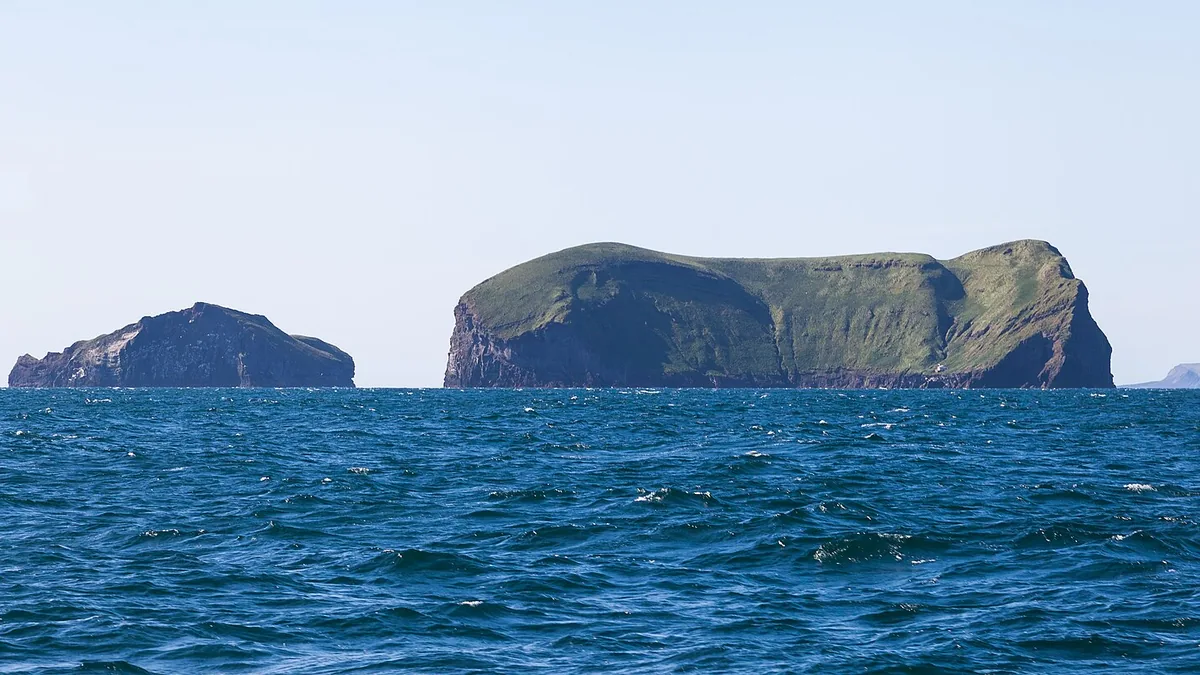
The island that appeared off the southern coast of Iceland in the 1960s is the most studied new island in the world, and it exists as a scientific resource precisely because access has been restricted since it formed. The eruption lasted several years, built an island of roughly a square mile, and then stopped.
Because almost nobody has been allowed to set foot on it, Surtsey became a clean natural experiment: how does life arrive on entirely new land, and in what order? The answers have been more interesting than expected. Plants arrived within a few years, carried by sea and by birds. Seabirds colonised and began enriching the soil with guano, which in turn allowed more plant species to establish. That feedback — birds enabling plants enabling more birds — is now understood as a general mechanism in primary succession.
The other finding is erosion. Surtsey has lost a substantial fraction of its original area to wave action, and it continues to shrink. What remains is the consolidated core, and the lesson is general: the ash apron goes, the hard core stays.
Nishinoshima: growth and reworking
A small island in the Pacific that erupted in the 2010s and again in the following decade demonstrates how dramatically a submarine volcano can change the map. Before the eruptions it was a small island; the eruptions added substantial new land, merged separate outcrops, and repeatedly reshaped the coastline.
What makes it instructive is that it shows both processes at once. New land is added by eruption, and existing land is simultaneously reworked by waves. Satellite monitoring has tracked the area growing during eruptive phases and being trimmed between them, and the pattern is exactly the competition between construction and erosion that governs all volcanic islands.
It also shows how quickly colonisation begins. Vegetation and birdlife from the original island spread onto the new land, and observers documented the progression in near real time.
When an island disappears again
A large eruption in the South Pacific in the early 2020s demonstrated the destructive side just as clearly. A submarine caldera that had built two small islands above the surface erupted catastrophically, and the explosion removed most of the land that had been there, along with a great deal of the submarine edifice.
The event produced one of the largest atmospheric disturbances ever recorded by modern instruments, with an ash plume reaching the upper atmosphere and a pressure wave that circled the globe. It is a reminder that the same processes that build islands can remove them, and that the shallow-water explosive regime is far more energetic than the deep one.
The surviving remnants are substantially smaller than what preceded them. In island terms, a decade of construction was undone in hours.
How long a new island lasts
The lifetime of a volcanic island depends on the balance between how fast it can be built and how fast waves can remove it. Three factors dominate.
Material: consolidated lava outlasts loose ash by orders of magnitude. An island that is mostly tephra is a temporary feature; an island with a welded or lava-capped core can persist for thousands of years.
Wave climate: islands in stormy latitudes are attacked far more aggressively than islands in calm tropical waters. The same material that survives in sheltered conditions is removed in an exposed one.
Sea level and subsidence: volcanic islands often sit on crust that subsides as it cools and as the edifice loads it. Combined with long-term sea-level change, this decides whether an island persists or eventually drowns, which is the fate of the majority of volcanic islands over geological time.
The general pattern in the geological record is that most seamounts never become islands, most islands that do appear are small and short-lived, and a small fraction grow large enough to persist for millions of years.
Why this matters beyond curiosity
New islands are natural laboratories. Because the starting point is known exactly — sterile rock at a known date — they let ecologists measure colonisation and succession in a way that is impossible anywhere else. Almost everything understood about primary succession comes from places like this.
They are also hazards. Submarine volcanoes that build islands are the same volcanoes that produce tsunamis, aviation ash hazards, and explosive events that can affect global climate briefly. Monitoring the ones near the surface is a practical concern, not an academic one.
And they answer a basic question about the earth: how much of the land surface was created this way. The answer is a great deal of it — island arcs, hotspot chains and large parts of some continents began as submarine volcanism.
How these islands are studied without being walked on
There is an obvious tension: the scientific value of a new island depends on it not being disturbed, and the observations needed to understand it require someone to look closely. Most of what is known about recent islands comes from methods that keep people off the surface.
Satellite imagery does most of the work. Repeated passes measure area, shape and change over time, track plume height during eruptions, and record exactly when the coastline advanced or retreated. For a feature that may exist for months, this provides a record that would be impossible to gather any other way.
Uncrewed aircraft and remote cameras fill in the detail — the distribution of vegetation, the bird species present, the nests and the colony sizes. Where access is permitted at all, it is usually tightly controlled, with strict cleaning protocols for footwear and equipment because a single introduced seed or insect changes the experiment permanently. This is why visitors are excluded from some new islands entirely, and why the restriction is not an administrative quirk but the whole basis of the science.
Conclusion
Building an island requires an eruption to grow from the sea floor, reach shallow water where gas can expand explosively, and break the surface faster than waves can remove what it builds. Ash islands are built fast and removed fast; lava-capped islands consolidate and persist. Surtsey shows what happens when colonization is left alone, and recent Pacific eruptions show both dramatic growth and dramatic removal. Most submarine volcanoes never surface at all, and most islands that do surface eventually disappear — which is what makes the few that remain so remarkable.
Keep reading
Beyond Machu Picchu: 8 Inca Sites Almost Nobody Visits
Choquequirao, Wari terraces and fortress complexes that see a fraction of Machu Picchu's visitors. Where they are and what the hike involves.
Europe's Deepest Canyon Is Not Where You Think: The Tara River Gorge
The Tara River Canyon cuts deeper than most famous European gorges. How it formed, how it compares to the world's big canyons and how to see it.
New Zealand's Great Walks: The Four Almost Nobody Books
Most hikers book the Routeburn and Milford. These four Great Walks get a fraction of the traffic with the same alpine and coastal scenery.
